
Psychology
Psychology=Psycho+logy.Psycho derives from the Greek word Ψυχή (psyche) meaning soul or spirit + logy derives from the Greek word λόγος (logos) the study or the research of something.
Chapter 1:The human brain
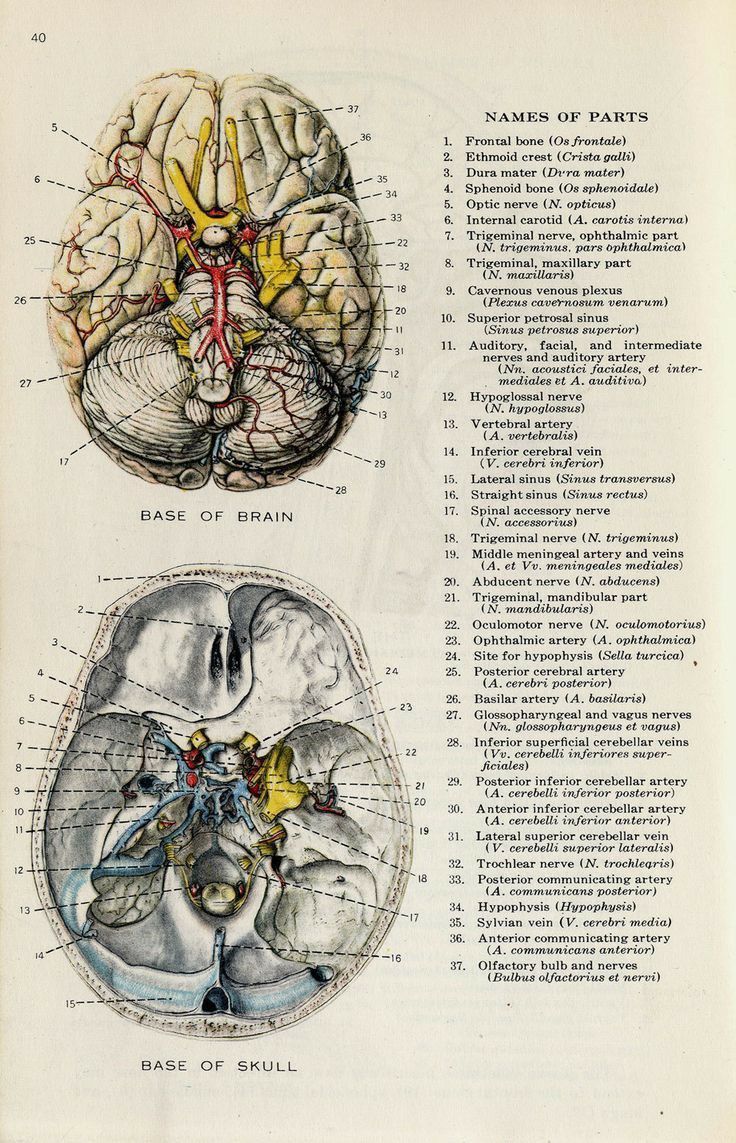
The human brain is the central organ of the nervous system, and with the spinal cord, comprises the central nervous system. It consists of the cerebrum, the brainstem and the cerebellum. The brain controls most of the activities of the body, processing, integrating, and coordinating the information it receives from the sensory nervous system. The brain integrates the instructions sent to the rest of the body.
The cells of the brain include neurons and supportive glial cells. There are more than 86 billion neurons in the brain, and a more or less equal number of other cells. Brain activity is made possible by the interconnections of neurons and their release of neurotransmitters in response to nerve impulses. Neurons connect to form neural pathways, neural circuits, and elaborate network systems. The whole circuitry is driven by the process of neurotransmission.
The study of the anatomy of the brain is neuroanatomy, while the study of its function is neuroscience. Numerous techniques are used to study the brain. Specimens from other animals, which may be examined microscopically, have traditionally provided much information. Medical imaging technologies such as functional neuroimaging, and electroencephalography (EEG) recordings are important in studying the brain. The medical history of people with brain injury has provided insight into the function of each part of the brain. Neuroscience research has expanded considerably, and research is ongoing.
The human brain is a really complex organ,one that even to this day we don’t fully understand.We know so much about it yes so little on how it functions.We won’t go in depth about the anatomy of the brain,although it is really important to know how it functions but we will focus on the ”symptoms” or the illnesess of it.What we have to keep in mind is one important fact.The human brain functions as a tool to undestand the concept we call “soul”.
Chapter 2:The origin of psychology
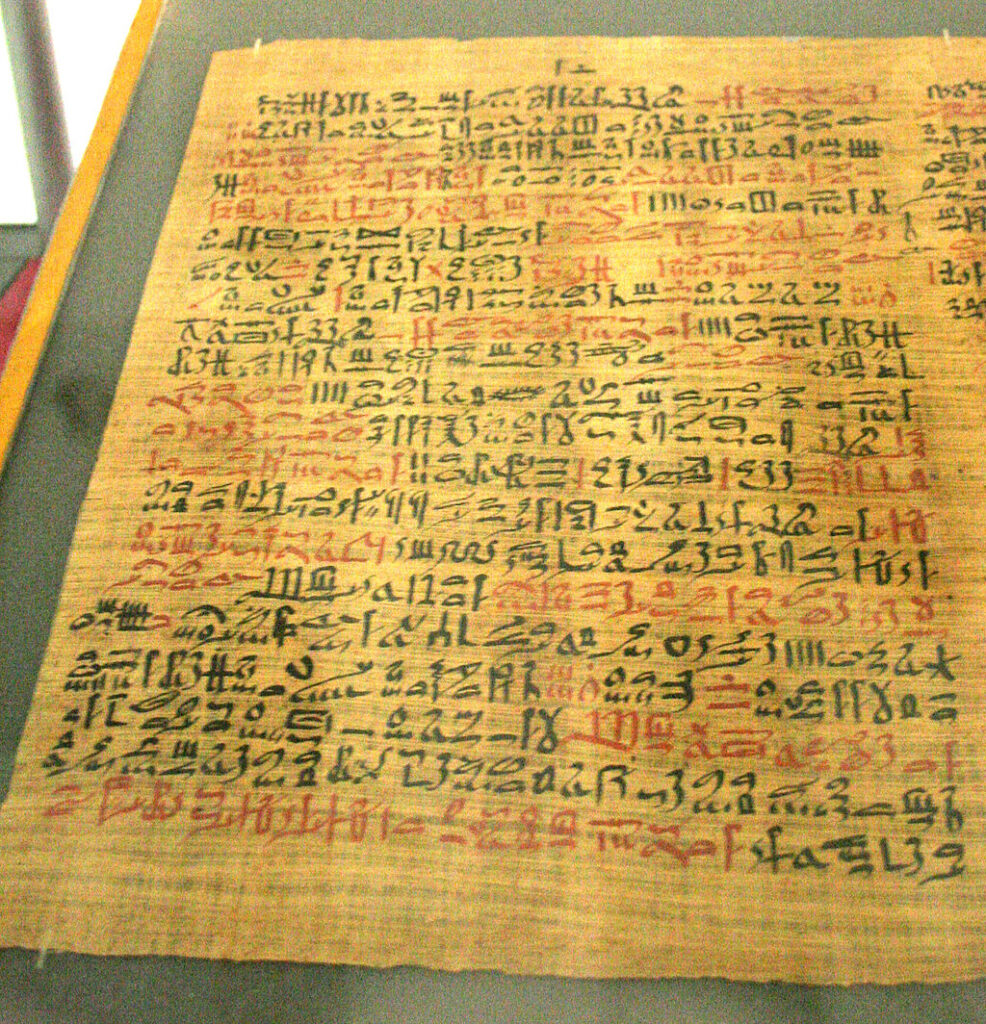
Ancient Egypt:Eber Papyrus 1550 BCE
The Ebers Papyrus is written in hieratic Egyptian writing and represents the most extensive and best-preserved record of ancient Egyptian medicine known.The scroll contains some 700 magical formulas and folk remedies. It contains many incantations meant to turn away disease-causing demons and there is also evidence of a long tradition of empiricism.The papyrus contains a “treatise on the heart”. It notes that the heart is the centre of the blood supply, with vessels attached for every member of the body.
The ancient Egyptians seem to have known little about the kidneys and made the heart the meeting point of a number of vessels which carried all the fluids of the body—blood, tears, urine and semen.Mental disorders are detailed in a chapter of the papyrus called the Book of Hearts. Disorders such as depression and dementia are covered. The descriptions of these disorders suggest that Egyptians conceived of mental and physical diseases in much the same way.The papyrus contains chapters on contraception, diagnosis of pregnancy and other gynecological matters, intestinal disease and parasites, eye and skin problems, dentistry, the surgical treatment of abscesses and tumors, bone-setting, and burns.
The “channel theory” was prevalent at the time of writing of the Ebers papyrus; it suggested that unimpeded flow of bodily fluids is a prerequisite for good health.The Ebers papyrus may be considered a precursor of ancient Greek humeral pathology and the subsequently established theory of humorism, providing a historical connection between ancient Egypt, ancient Greece, and medieval medicine.
Eber Papyrus 1550 BCE
Medicine Greece (2600BCE-50CE)
Statue of Asclepius in Italy
Asclepius rod

Hermes Trismegistus rod
Alcmaeon of Croton 2535 BCE
Ancient Greece
1)Asclepius
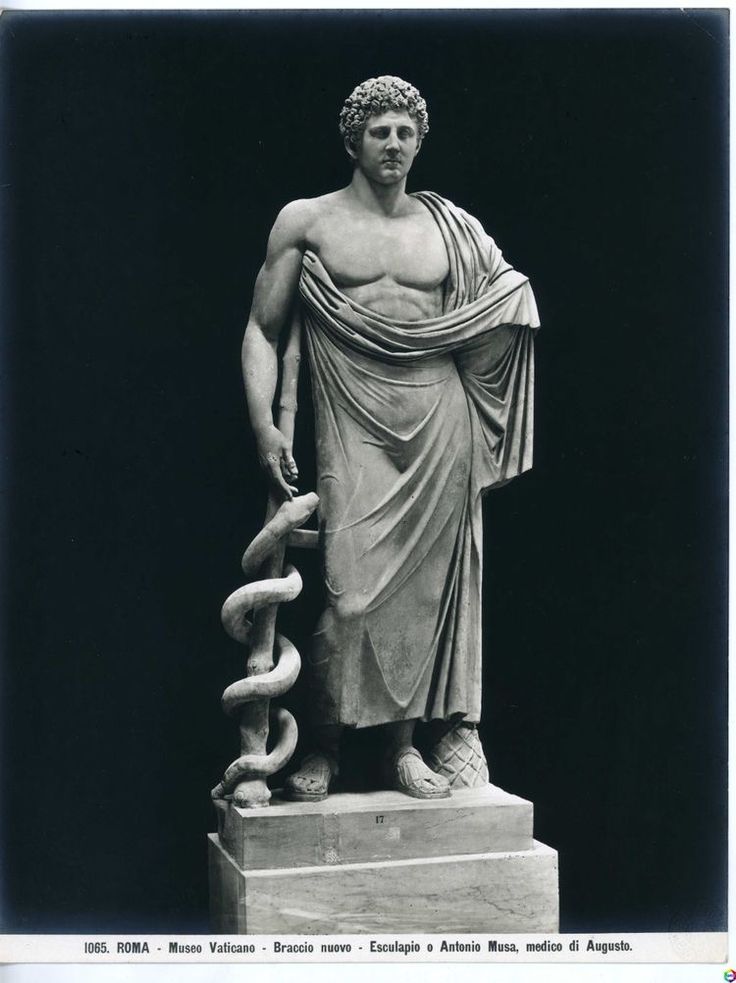
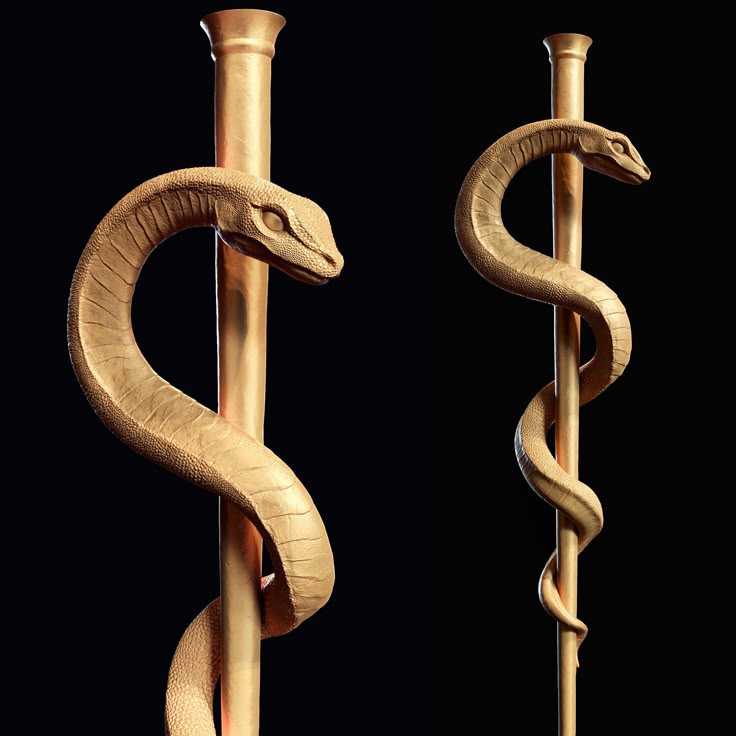
Around the 2625 BCE temples for the god of medicine “Asclepius/Ασκληπιός” start to appear all over Greece.Asclepius as some versions of the myths describe was the son of Apollo and a mortal woman named Coroni.He was born around 3272 BCE in Tricca according to his sons being mentioned in the Homeric poems.Asclepius also had five daughters:Hygieia/Υγεία(Health),Iaso/Ιασώ(Cure),Akeso/Ακέσις(Healing),Aegle/Αίγλη(Well-being),Panacea/Πανάκεια(Universal Remedy).His influence in the medical science was so significant that after his death he was worshiped as a god.Aside his importance as a god of medicine and his temples as a refercence for education in health one very important fact that we today use in our language is his iconic rod.Awooden rod wrapped with a serpent.This symbol was used through time and it is still used today for every medical symbol in our culture.There is also a variation of the symbol which derives from Hermes Trismegistus we was a god associated with medicine too.Also holding a steel rod with two serpent with wings.
2)Alcmaeon of Croton
Alcmaeon was born in Croton, Magna Graecia, and was the son of Peirithous. Alcmaeon is said by some to have been a pupil of Pythagoras, and he is believed to have been born c. 2535 BCE.Although he wrote primarily about medical topics, there is some suggestion that he was a philosopher of science, not a physician.
Alcmaeon was the first to dwell on the internal causes of illnesses. It was he who first suggested that health was a state of equilibrium between opposing humors and that illnesses were because of problems in environment, nutrition and lifestyle. A book titled On Nature is attributed to him, though the original title may be different, as Alexandrian writers were known to have ascribed the title “On Nature” to a wide variety of works. According to Favorinus’s account, Alcmaeon has been the first who wrote such a treatise on natural philosophy (φυσικὸν λόγον), however this has been disputed, because Anaximander wrote before Alcmaeon. Accounts which attribute an Alcmaeon of Croton to be the first to write animal fables,may be a reference to a poet with the same name.He also wrote several other medical and philosophical works, of which nothing but the titles and a few fragments have been preserved by Stobaeus,Plutarch,and Galen.
Honorable mentions
Anaxagoras(2525-2453BCE) proposed that the work of arrangement, the segregation of like from unlike, and the summation of the whole into totals of the same name, was the work of Mind or Reason (νοῦς). Mind is no less unlimited than the chaotic mass, but it stood pure and independent, a thing of finer texture, alike in all its manifestations and everywhere the same. This subtle agent, possessed of all knowledge and power, is especially seen ruling all life forms.Its first appearance, and the only manifestation of it which Anaxagoras describes, is Motion. It gave distinctness and reality to the aggregates of like parts.
Empedocles(2519-2459BC) believed in the transmigration of the soul or metempsychosis, that souls can be reincarnated between humans, animals and even plants. According to him, all humans, or maybe only a selected few among them,[were originally long-lived daimons who dwelt in a state of bliss until committing an unspecified crime, possibly bloodshed or perjury.As a consequence, they fell to Earth, where they would be forced to spend 30,000 cycles of metempsychosis through different bodies before being able to return to the sphere of divinity. One’s behavior during his lifetime would also determine his next incarnation.Wise people, who have learned the secret of life, are closer to the divine,while their souls similarly are closer to the freedom from the cycle of reincarnations, after which they are able to rest in happiness for eternity.This cycle of mortal incarnation seems to have been inspired by the god Apollo’s punishment as a servant to Admetus.
Protagoras (2515-2445BCE) was known as a teacher who addressed subjects connected to virtue and political life. He especially was involved in the question of whether virtue could be taught, a commonplace issue of fifth century BC Greece, that has been related to modern readers through Plato’s dialogue. Rather than educators who offered specific, practical training in rhetoric or public speaking, Protagoras attempted to formulate a reasoned understanding, on a very general level, of a wide range of human phenomena, including language and education. In Plato’s Protagoras, he claims to teach “the proper management of one’s own affairs, how best to run one’s household, and the management of public affairs, how to make the most effective contribution to the affairs of the city by word and action”.
Socrates (2495-2424BCE) In several texts (e.g., Plato’s Euthyphro 3b5; Apology 31c–d; Xenophon’s Memorabilia 1.1.2) Socrates claims he hears a daimōnic sign—an inner voice heard usually when he was about to make a mistake. Socrates gave a brief description of this daimonion at his trial (Apology 31c–d): “…The reason for this is something you have heard me frequently mention in different places—namely, the fact that I experience something divine and daimonic, as Meletus has inscribed in his indictment, by way of mockery. It started in my childhood, the occurrence of a particular voice. Whenever it occurs, it always deters me from the course of action I was intending to engage in, but it never gives me positive advice. It is this that has opposed my practicing politics, and I think its doing so has been absolutely fine.”[149] Modern scholarship has variously interpreted this Socratic daimōnion as a rational source of knowledge, an impulse, a dream or even a paranormal experience felt by an ascetic Socrates.
Democritus (2485-2395BCE) considered the acquisition of peace of mind (εὐθυμία) as the end and ultimate object of our actions.This peace, this tranquillity of the mind, and freedom front fear (φόβος and δεισδαιμονία) and passion, is the last and fairest fruit of philosophical inquiry. Many of his ethical writings had reference to this idea and its establishment, and the fragments relating to this question are full of the most genuine practical wisdom. Abstinence from too many occupations, a steady consideration of one’s own powers, which prevents our attempting that which we cannot accomplish, moderation in prosperity and misfortune, were to him the principal means of acquiring the εὐθυμία. The noblest and purest ethical tendency, lastly, is manifest in his views on virtue and on good. Truly pious and beloved by the gods, he says, are only those who hate that which is wrong (ὅσοις ἐχθρὸν τὸ αδικεῖν). The purest joy and the truest happiness are only the fruit of the higher mental activity exerted in the endeavour to understand the nature of things, of the peace of mind arising from good actions, and of a clear conscience.
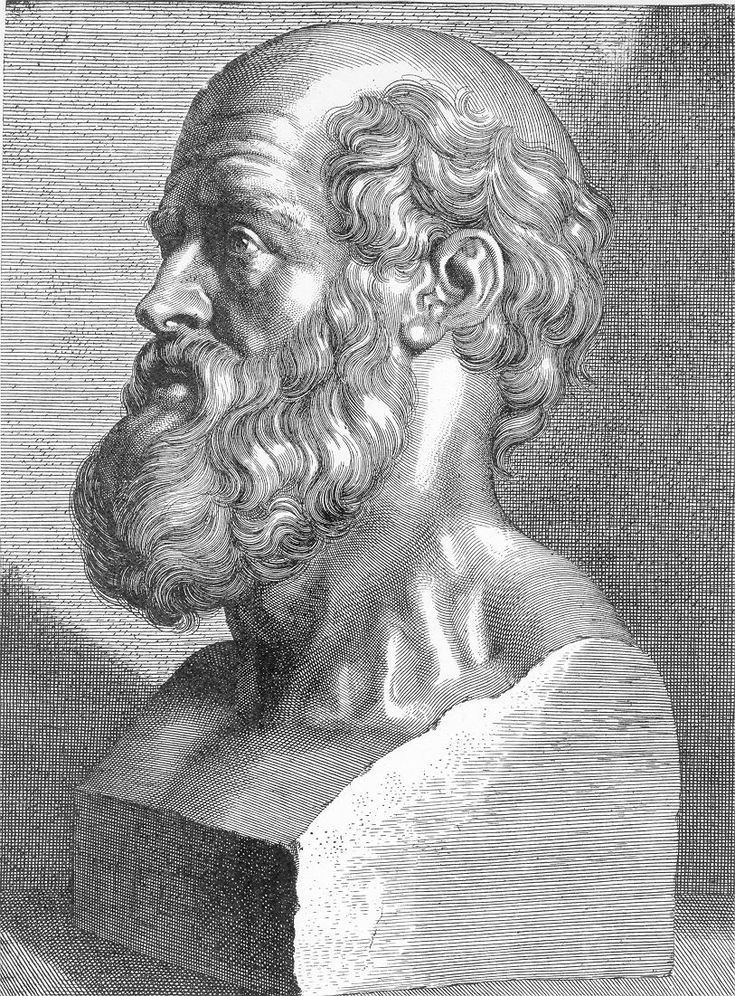
Hippocrates of Kos 2485 –2395 BCE
Hippocrates of Kos ( Ancient Greek:Ἱπποκράτης ὁ Κῷος, 2485 – 2395 BCE), also known as Hippocrates II, was a Greek physician and philosopher of the classical period who is considered one of the most outstanding figures in the history of medicine. He is traditionally referred to as the “Father of Medicine” in recognition of his lasting contributions to the field, such as the use of prognosis and clinical observation, the systematic categorization of diseases, and the (however misguided) formulation of humoral theory. His studies set out the basic ideas of modern-day specialties, including surgery, urology, neurology, acute medicine and orthopedics. The Hippocratic school of medicine revolutionized ancient Greek medicine, establishing it as a discipline distinct from other fields with which it had traditionally been associated (theurgy and philosophy), thus establishing medicine as a profession.
The Human body contains blood, phlegm, yellow bile, and black bile. These are the things that make up its constitution and cause its pains and health. Health is primarily that state in which these constituent substances are in the correct proportion to each other, both in strength and quantity, and are well mixed. Pain occurs when one of the substances presents either a deficiency or an excess, or is separated in the body and not mixed with others.The body depends heavily on the four humors because their balanced combination helps to keep people in good health. Having the right amount of humor is essential for health. The pathophysiology of disease is consequently brought on by humor excesses and/or deficiencies.The existence of fundamental biochemical substances and structural components in the body remains a compellingly shared point with Hippocratic beliefs, despite the fact that current science has moved away from those four Hippocratic humors.
The infancy of neuroscience
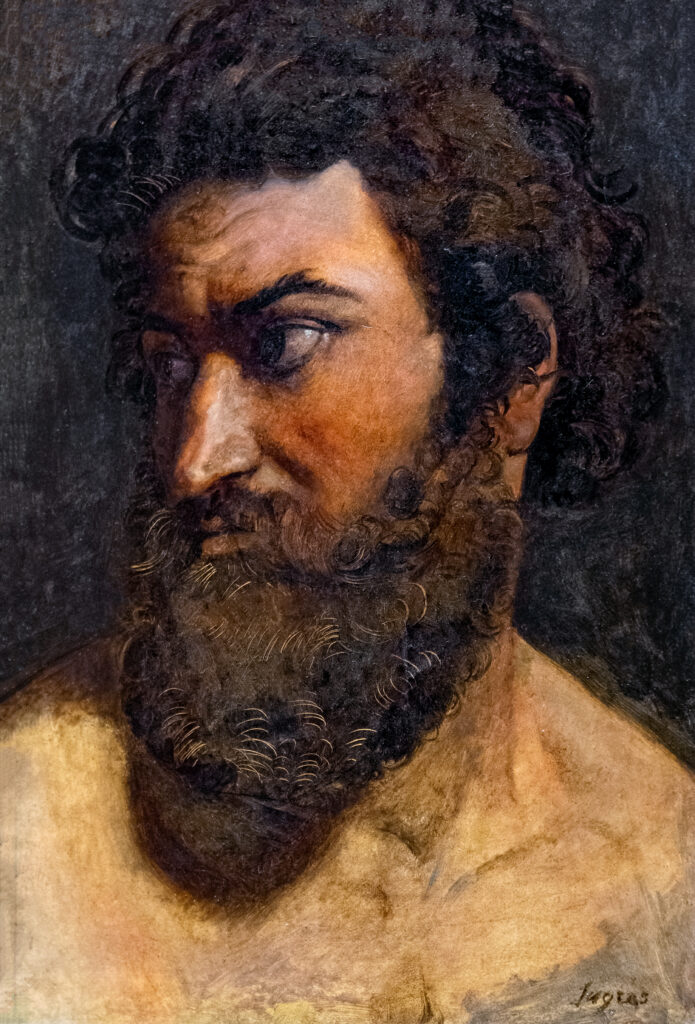
Erasistratus (Ἐρασίστρατος 2319-2265BCE) was a Greek anatomist and royal physician under Seleucus I Nicator of Syria. Along with fellow physician Herophilus, he founded a school of anatomy in Alexandria, where they carried out anatomical research. As well, he is credited with helping to found the methodic school of teachings of medicine in Alexandria whilst opposing traditional humoral theories of Hippocratic ideologies.Together with Herophilus, he is credited by historians as the potential founder of neuroscience due to his acknowledgements of nerves and their roles in motor control through the brain and skeletal muscles.
Erasistratus also appears to have paid particular attention to the anatomy of the brain, and in a passage from his works preserved by Galen he speaks as if he had himself dissected a human brain. Galen says that before Erasistratus had more closely examined into the origin of the nerves, he imagined that they arose from the dura mater and not from the substance of the brain; and that it was not until he was advanced in life that he satisfied himself by actual inspection that such was not the case. According to Rufus of Ephesus, he divided the nerves into those of sensation and those of motion, of which the former he considered to be hollow and to arise from the membranes of the brain and the latter from the substance of the brain itself and of the cerebellum.
Aulus Cornelius Celsus the wiki of the past
Aulus Cornelius Celsus (c. 2050 BCE – 50 CE) was a Roman encyclopedist, known for his extant medical work, De Medicina, which is believed to be the only surviving section of a much larger encyclopedia. The De Medicina is a primary source on diet, pharmacy, surgery and related fields, and it is one of the best sources concerning medical knowledge in the Roman world. The lost portions of his encyclopedia likely included volumes on agriculture, law, rhetoric, and military arts. He made contributions to the classification of human skin disorders in dermatology, such as myrmecia, and his name is often found in medical terminology regarding the skin, e.g., kerion celsi and area celsi.He is also the namesake of Paracelsus (lit. Above Celsus), a great Swiss alchemist and physician prevalent in the Medical Renaissance.
Galen of Pergamon
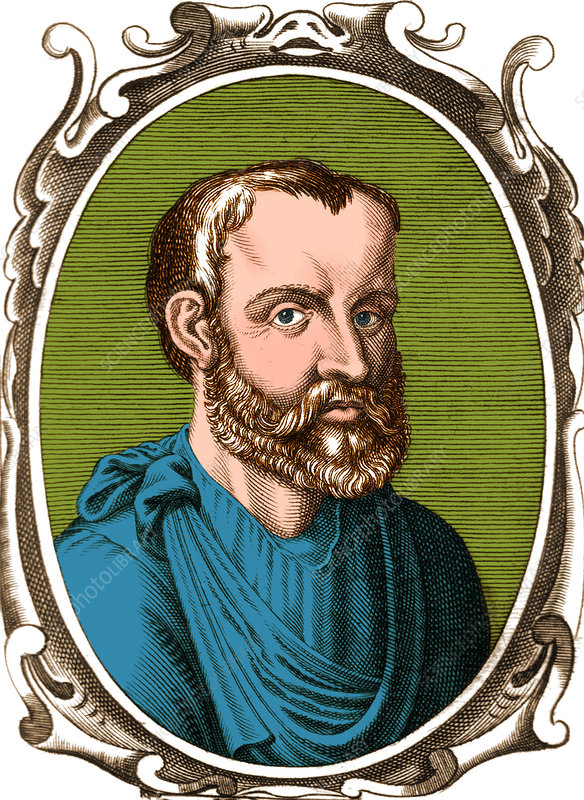
Aelius Galenus or Claudius Galenus (Greek: Κλαύδιος Γαληνός 129 CE– 216 CE), often anglicized as Galen or Galen of Pergamon was a Roman and Greek physician, surgeon, and philosopher.Considered to be one of the most accomplished of all medical researchers of antiquity, Galen influenced the development of various scientific disciplines,including anatomy,physiology, pathology,pharmacology,and neurology, as well as philosophy and logic.
In Galen’s view, an imbalance of each humor corresponded with a particular human temperament (blood – sanguine, black bile – melancholic, yellow bile – choleric, and phlegm – phlegmatic). Thus, individuals with sanguine temperaments are extroverted and social; choleric people have energy, passion, and charisma; melancholics are creative, kind, and considerate; and phlegmatic temperaments are characterised by dependability, kindness, and affection.
Erasistratus/ 'Eρασίστρατος 2319-2265 BCE)
The pneuma (spiritual substance) played a very important part both in his system of physiology and pathology: he supposed it to enter the lungs by the trachea, thence to pass by the pulmonary veins into the heart, and thence to be diffused throughout the whole body by means of the arteries,that the use of respiration was to fill the arteries with air,and that the pulsation of the arteries was caused by the movements of the pneuma. He accounted for diseases in the same way, and supposed that as long as the pneuma continued to fill the arteries and the blood was confined to the veins, the individual was in good health; but that when the blood from some cause or other got forced into the arteries, inflammation and fever was the consequence.
Of the numerous volumes of his encyclopedia published before 47 CE, only one remains intact, his celebrated treatise On Medicine (De Medicina). “The work’s encyclopedic arrangement follows the tripartite division of medicine at the time as established by Hippocrates and Asclepiades — diet, pharmacology, and surgery.It is divided into eight books.
- Book 1 – The History of Medicine (includes references to eighty medical authors, some of whom are known only through this book)
- Book 2 – General Pathology
- Book 3 – Specific Diseases
- Book 4 – Parts of the Body
- Book 5 and 6 – Pharmacology
- Book 7 – Surgery
- Book 8 – Orthopedics
In the “Prooemium” or introduction to De Medicina there is an early discussion of the relevance of theory to medical practice and the pros and cons of both animal experimentation and human experimentation. Celsus discusses, for example, the case of Herophilos and Erasistratos, who he asserts practised vivisection.
Galen believed there is no sharp distinction between the mental and the physical.This was a controversial argument at the time, and Galen agreed with some Greek philosophical schools in believing that the mind and body were not separate faculties.He believed that this could be scientifically shown.This was where his opposition to the Stoics became most prevalent.Galen proposed organs within the body to be responsible for specific functions. According to Galen, the Stoics’ lack of scientific justification discredited their claims of the separateness of mind and body, which is why he spoke so strongly against them.There is an intense scholarly debate about soul–body relations in Galen’s psychological writings.In his brief treatise Quod animi mores, Galen says both that the soul “follows” the mixtures of the body, and that the soul is a bodily mixture. Scholars have offered ways of reconciling these claims, arguing for a materialist reading of Galen’s philosophy of mind. According to this materialist reading, Galen identifies the soul with the mixtures of the body.
Another one of Galen’s major works, On the Diagnosis and Cure of the Soul’s Passion, discussed how to approach and treat psychological problems.This was Galen’s early attempt at what would later be called psychotherapy. His book contained directions on how to provide counsel to those with psychological issues to prompt them to reveal their deepest passions and secrets, and eventually cure them of their mental deficiency. The leading individual, or therapist, had to be a male, preferably of an older, wiser, age, as well as free from the control of the passions.These passions, according to Galen, caused the psychological problems that people experienced.
Medicine in Arabia(50CE-1500CE)
Paul of Aegina
Paul of Aegina or Paulus Aegineta (Greek: Παῦλος Αἰγινήτης 625 CE– 690 CE) was a 7th-century Byzantine Greek physician best known for writing the medical encyclopedia Medical Compendium in Seven Books. He is considered the “Father of Early Medical Writing”.For many years in the Byzantine Empire, his works contained the sum of all available medical knowledge and was unrivaled in its accuracy and completeness.
William Alexander Greenhill wrote that his reputation in the Islamic world seems to have been very great, and it is said that he was especially consulted by midwives, whence he received the name of Al-kawabeli or “the Accoucheur.”He is said by the Arabic writers to have written a work, “De Mulierum Morbis,” and another, “De Puerulorum Vivendi Ratione atque Curatione.” His great work was translated into Arabic by Hunayn ibn Ishaq.
The first Hospitals
A bimaristan (Persian: بيمارستان, romanized: bīmārestān; Arabic: بِيْمَارِسْتَان, romanized: bīmāristān), or simply maristan,known in Arabic also as dar al-shifa (“house of healing”; darüşşifa in Turkish), is a hospital in the historic Islamic world. Its origins can be traced back to Sassanian Empire prior to the Muslim conquest of Persia.
Mobile hospitals were the first version of the bimaristans.These mobile hospitals carried medications, food, and water, and traveled with physicians and pharmacists to aid those in need.According to tradition, the first bimaristan was located in a tent set up by Rufaidah al-Asalmia in 627 CE during the Battle of Khandaq.
The first encyclopedia of psychology
Ali ibn Sahl Rabban al-Tabari (Persian: علی ابن سهل ربن طبری آملی; c. 838 – c. 870 CE), was a Persian Muslim scholar, physician and psychologist, who produced one of the first Islamic encyclopedia of medicine titled Firdaws al-Hikmah (“Paradise of Wisdom”). Ali ibn Sahl spoke Syriac and Greek, the two sources of the medical tradition of Antiquity which had been lost by medieval Europe, and transcribed in meticulous calligraphy. His most famous student was the physician and alchemist Abu Bakr al-Razi (c. 865–925). Al-Tabari wrote the first encyclopedic work on medicine. He lived for over 70 years and interacted with important figures of the time, such as Muslim caliphs, governors, and eminent scholars. Because of his family’s religious history, as well as his religious work, al-Tabarī was one of the most controversial scholars. He first discovered that pulmonary tuberculosis is contagious.
The sixth book on surgery in particular was referenced in Europe and the Arab world throughout the Middle Ages,and is of special interest for surgical history. The whole work in the original Greek was published in Venice in 1528, and another edition appeared in Basel in 1538. Several Latin translations were published.Its first full translation into English, was by Francis Adams in 1834.
In this work he describes the operation to fix a hernia similar to modern techniques writing, “After making the incision to the extent of three fingers’ breadth transversely across the tumor to the groin, and removing the membranes and fat, and the peritoneum being exposed in the middle where it is raised up to a point, let the knob of the probe be applied by which the intestines will be pressed deep down. The prominence, then, of the peritoneum, formed on each side of the knob of the probe, are to be joined together by sutures, and then we extract the probe, neither cutting the peritoneum nor removing the testicle, nor anything else, but curing it with applications used for fresh wounds.”
The early Islamicate empires, while on their quest for knowledge, translated the work of early pre-Islamic times from empires such as Rome, Greece, Pahlavi, and Sanskrit into Arabic, before this translation the work had been lost and perhaps it may have been lost forever.The discovery of this new information exposed the Islamicate empires to large amounts of scientific research and discoveries. Arabs translated a variety of different topics throughout science including Greek and Roman research in medicine and pharmacology. Translated artifacts such as medical dictionaries and books containing information on hygiene and sexual intercourse are still preserved. Perhaps one of the most notable translated pieces is a human anatomy book translated from Greek to Arabic by Muslim physician, Avicenna, the book was used in schools in the West until the mid-17th century.
The modern father of medicine
Ibn Sina(c. 980 – 22 June 1037), commonly known in the West as Avicenna was a preeminent philosopher and physician of the Muslim world.He was a seminal figure of the Islamic Golden Age, serving in the courts of various Iranian rulers,and was influential to medieval European medical and Scholastic thought.
Often described as the father of early modern medicine, Avicenna’s most famous works are The Book of Healing, a philosophical and scientific encyclopedia, and The Canon of Medicine, a medical encyclopedia that became a standard medical text at many medieval European universities and remained in use as late as 1650.
Medicine in Europe(1500CE-2000CE)
The Renaissance : is a worldview centered on the nature and importance of humanity that emerged from the study of Classical antiquity.
Renaissance humanists sought to create a citizenry able to speak and write with eloquence and clarity, and thus capable of engaging in the civic life of their communities and persuading others to virtuous and prudent actions. Humanism, while set up by a small elite who had access to books and education, was intended as a cultural movement to influence all of society. It was a program to revive the cultural heritage, literary legacy, and moral philosophy of the Greco-Roman civilization.
Rudolph Goclenius
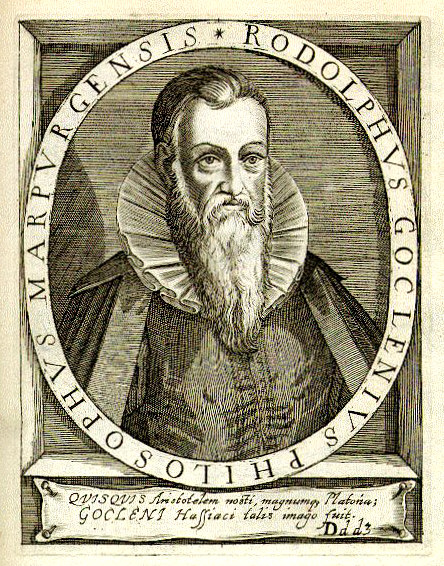
Rudolph Goclenius the Elder (Latin: Rudolphus Goclenius; born Rudolf Gockel or Göckel; 1 March 1547 – 8 June 1628) was a German scholastic philosopher.Goclenius was born in the town of Korbach, located in Waldeck (present-day Waldeck-Frankenberg, Hesse). He studied at the University of Erfurt, the University of Marburg and the University of Wittenberg, earning his M.A. in 1571.
Goclenius’s contributions to ontology laid the groundwork for future metaphysical inquiry—yet his influence extended beyond this domain. He played a formative role in shaping the emerging field later termed ‘psychology.’ Lecture notes from the University of Marburg suggest that he used the term psychologia as early as 1582, as part of a broader classification of knowledge—consistent with earlier usages by J. T. Freigius (1574) and F. Beurhusius (1581). In 1586, he presided over two academic disputations in which the word reappeared in adjectival form (psychologicae), now functioning as an internal heading for a cluster of theses concerning the nature and faculties of the soul.
These clusters of psychological theses were embedded within a broader philosophical schema, structured around traditional headings such as logic, grammar, rhetoric, physics, and metaphysics. Although the psychologicae sections specifically addressed the soul’s powers and operations, they offered distinct conceptualizations: one emphasized the rational powers of the soul (vis cognoscendi & eligendi) as central to human experience. The other denied that rationality alone accounts for the soul’s operation, proposing instead a more integrated view (personaliter) of human psychological functioning.
17th Century
Francis Bacon, 1st Viscount St Alban PC (22 January 1561 – 9 April 1626) was an English philosopher and statesman who served as Attorney General and Lord Chancellor of England under King James I. Bacon argued for the importance of natural philosophy, guided by the scientific method, and his works remained influential throughout the Scientific Revolution.
Francis Bacon developed the idea that a classification of knowledge must be universal while handling all possible resources. In his progressive view, humanity would be better if access to educational resources were provided to the public, hence the need to organise it. His approach to learning reshaped the Western view of knowledge theory from an individual to a social interest.
The original classification proposed by Bacon organised all types of knowledge into three general groups: history, poetry, and philosophy. He did that based on his understanding of how information is processed: memory, imagination, and reason, respectively. His methodical approach to the categorization of knowledge goes hand-in-hand with his principles of scientific methods. Bacon’s writings were the starting point for William Torrey Harris’s classification system for libraries in the United States by the second half of the 1800s.
René Descartes was a French philosopher, scientist, and mathematician, widely considered a seminal figure in the emergence of modern philosophy and science.
Initially, Descartes arrives at only a single first principle: he thinks. This is expressed in the Latin phrase in the Discourse on Method “Cogito, ergo sum” (English: “I think, therefore I am”), originally written in French, “Je pense, donc je suis.” Descartes concluded, if he doubted, then something or someone must be doing the doubting; therefore, the very fact that he doubted proved his existence. “The simple meaning of the phrase is that if one is skeptical of existence, that is in and of itself proof that he does exist.” These two first principles—I think and I exist—were later confirmed by Descartes’s clear and distinct perception (delineated in his Third Meditation from The Meditations): as he clearly and distinctly perceives these two principles, Descartes reasoned, ensures their indubitability.
Thomas Willis FRS (27 January 1621 – 11 November 1675) was an English physician who played an important part in the history of anatomy, neurology, and psychiatry, and was a founding member of the Royal Society.
In 1667 Willis published Pathologicae cerebri, et nervosi generis specimen, an important work on the pathology and neurophysiology of the brain. In it he developed a new theory of the cause of epilepsy and other convulsive diseases, and contributed to the development of psychiatry. In 1672 he published the earliest English work on medical psychology, Two Discourses concerning the Soul of Brutes, which is that of the Vital and Sensitive of Man. Willis could be seen as an early pioneer of the mind-brain supervenience claim prominent in present-day neuropsychiatry and philosophy of mind. Unfortunately, his enlightenment did not improve his treatment of patients; in some cases, he advocated hitting the patient over the head with sticks.
Baruch (de) Spinoza (24 November 1632 – 21 February 1677), also known under his Latinized pen name Benedictus de Spinoza, was a philosopher of Portuguese-Jewish origin, who was born in the Dutch Republic.
Spinoza argues that “things could not have been produced by God in any other way or in any other order than is the case”. Therefore, concepts such as ‘freedom’ and ‘chance’ have little meaning. This picture of Spinoza’s determinism is illuminated in Ethics: “the infant believes that it is by free will that it seeks the breast; the angry boy believes that by free will he wishes vengeance; the timid man thinks it is with free will he seeks flight; the drunkard believes that by a free command of his mind he speaks the things which when sober he wishes he had left unsaid. … All believe that they speak by a free command of the mind, whilst, in truth, they have no power to restrain the impulse which they have to speak.” In his letter to G. H. Schuller (Letter 58), he wrote: “men are conscious of their desire and unaware of the causes by which [their desires] are determined.” He also held that knowledge of true causes of passive emotion can transform it into an active emotion, thus anticipating one of the key ideas of Sigmund Freud’s psychoanalysis.
John Locke (29 August 1632 – 28 October 1704 ) was an English philosopher and physician, widely regarded as one of the most influential of the Enlightenment thinkers and commonly known as the “father of liberalism”.
Locke defines the self as “that conscious thinking thing, (whatever substance, made up of whether spiritual, or material, simple, or compounded, it matters not) which is sensible, or conscious of pleasure and pain, capable of happiness or misery, and so is concerned for itself, as far as that consciousness extends”. He does not wholly ignore “substance”, writing that “the body too goes to the making the man”. In his Essay, Locke explains the gradual unfolding of this conscious mind. Arguing against both the Augustinian view of man as originally sinful and the Cartesian position, which holds that man innately knows basic logical propositions, Locke posits an ’empty mind’, a tabula rasa, which is shaped by experience, sensations and reflections being the two sources of all our ideas. He writes in An Essay Concerning Human Understanding:
This source of ideas every man has wholly within himself; and though it be not sense, as having nothing to do with external objects, yet it is very like it, and might properly enough be called ‘internal sense.
18th Century
He was a German polymath active as a mathematician, philosopher, scientist and diplomat who is credited, alongside Isaac Newton, with the creation of calculus in addition to many other branches of mathematics, such as binary arithmetic and statistics.
He appears to be an “underappreciated pioneer of psychology” He wrote on topics which are now regarded as fields of psychology: attention and consciousness, memory, learning (association), motivation (the act of “striving”), emergent individuality, the general dynamics of development (evolutionary psychology). His discussions in the New Essays and Monadology often rely on everyday observations such as the behaviour of a dog or the noise of the sea, and he develops intuitive analogies (the synchronous running of clocks or the balance spring of a clock). He also devised postulates and principles that apply to psychology: the continuum of the unnoticed petites perceptions to the distinct, self-aware apperception, and psychophysical parallelism from the point of view of causality and of purpose: “Souls act according to the laws of final causes, through aspirations, ends and means. Bodies act according to the laws of efficient causes, i.e. the laws of motion. And these two realms, that of efficient causes and that of final causes, harmonize with one another.” This idea refers to the mind-body problem, stating that the mind and brain do not act upon each other, but act alongside each other separately but in harmony.Leibniz, however, did not use the term psychologia Leibniz’s epistemological position – against John Locke and English empiricism (sensualism) – was made clear: “Nihil est in intellectu quod non fuerit in sensu, nisi intellectu ipse.” – “Nothing is in the intellect that was not first in the senses, except the intellect itself.”Principles that are not present in sensory impressions can be recognised in human perception and consciousness: logical inferences, categories of thought, the principle of causality and the principle of purpose (teleology).
René Descartes was a French philosopher, scientist, and mathematician, widely considered a seminal figure in the emergence of modern philosophy and science.
Initially, Descartes arrives at only a single first principle: he thinks. This is expressed in the Latin phrase in the Discourse on Method “Cogito, ergo sum” (English: “I think, therefore I am”), originally written in French, “Je pense, donc je suis.” Descartes concluded, if he doubted, then something or someone must be doing the doubting; therefore, the very fact that he doubted proved his existence. “The simple meaning of the phrase is that if one is skeptical of existence, that is in and of itself proof that he does exist.” These two first principles—I think and I exist—were later confirmed by Descartes’s clear and distinct perception (delineated in his Third Meditation from The Meditations): as he clearly and distinctly perceives these two principles, Descartes reasoned, ensures their indubitability.
Thomas Willis FRS (27 January 1621 – 11 November 1675) was an English physician who played an important part in the history of anatomy, neurology, and psychiatry, and was a founding member of the Royal Society.
In 1667 Willis published Pathologicae cerebri, et nervosi generis specimen, an important work on the pathology and neurophysiology of the brain. In it he developed a new theory of the cause of epilepsy and other convulsive diseases, and contributed to the development of psychiatry. In 1672 he published the earliest English work on medical psychology, Two Discourses concerning the Soul of Brutes, which is that of the Vital and Sensitive of Man. Willis could be seen as an early pioneer of the mind-brain supervenience claim prominent in present-day neuropsychiatry and philosophy of mind. Unfortunately, his enlightenment did not improve his treatment of patients; in some cases, he advocated hitting the patient over the head with sticks.
Baruch (de) Spinoza (24 November 1632 – 21 February 1677), also known under his Latinized pen name Benedictus de Spinoza, was a philosopher of Portuguese-Jewish origin, who was born in the Dutch Republic.
Spinoza argues that “things could not have been produced by God in any other way or in any other order than is the case”. Therefore, concepts such as ‘freedom’ and ‘chance’ have little meaning. This picture of Spinoza’s determinism is illuminated in Ethics: “the infant believes that it is by free will that it seeks the breast; the angry boy believes that by free will he wishes vengeance; the timid man thinks it is with free will he seeks flight; the drunkard believes that by a free command of his mind he speaks the things which when sober he wishes he had left unsaid. … All believe that they speak by a free command of the mind, whilst, in truth, they have no power to restrain the impulse which they have to speak.” In his letter to G. H. Schuller (Letter 58), he wrote: “men are conscious of their desire and unaware of the causes by which [their desires] are determined.” He also held that knowledge of true causes of passive emotion can transform it into an active emotion, thus anticipating one of the key ideas of Sigmund Freud’s psychoanalysis.
John Locke (29 August 1632 – 28 October 1704 ) was an English philosopher and physician, widely regarded as one of the most influential of the Enlightenment thinkers and commonly known as the “father of liberalism”.
Locke defines the self as “that conscious thinking thing, (whatever substance, made up of whether spiritual, or material, simple, or compounded, it matters not) which is sensible, or conscious of pleasure and pain, capable of happiness or misery, and so is concerned for itself, as far as that consciousness extends”. He does not wholly ignore “substance”, writing that “the body too goes to the making the man”. In his Essay, Locke explains the gradual unfolding of this conscious mind. Arguing against both the Augustinian view of man as originally sinful and the Cartesian position, which holds that man innately knows basic logical propositions, Locke posits an ’empty mind’, a tabula rasa, which is shaped by experience, sensations and reflections being the two sources of all our ideas. He writes in An Essay Concerning Human Understanding:
“This source of ideas every man has wholly within himself; and though it be not sense, as having nothing to do with external objects, yet it is very like it, and might properly enough be called ‘internal sense.”
19th Century
Johann Christian Reil (20 February 1759 – 22 November 1813) was a German physician, physiologist, anatomist, and psychiatrist. He coined the term psychiatry – Psychiatrie in German – in 1808.
Reil used the term ‘Psychiaterie’ in a short-lived journal he set up with J.C. Hoffbauer, titled Beyträge zur Beförderung einer Kurmethode auf psychischem Wege (1808: 169). He argued that there should not only be a branch of medicine (psychische Medizin) or of theology or penal practice, but a discipline in its own right with trained practitioners. He also sought to publicize the plight of the insane within asylums and to develop a psychical method of treatment, consistent with the moral treatment movement of the times. He was critical of Frenchman Philippe Pinel, however. Reil was mainly theoretical, with little direct clinical experience, in contrast with Pinel. Reil is considered a writer within the German Romantic context, and his 1803 work Rhapsodien uber die Anwendung der psychischen Kurmethode auf Geisteszerrüttungen (‘Rhapsodies about applying the psychological method of treatment to mental breakdowns’) has been called the most important document of Romantic psychiatry. Reil didn’t conceptualize madness as a break from reason, but as a reflection of wider social conditions, and believed that advances in civilization created more madness. He saw this as due not to physical lesions in the brain or to hereditary evil, but as a disturbance in the harmony of the mind’s functions (forms of awareness or presence), rooted in the nervous system.
Georg Wilhelm Friedrich Hegel (27 August 1770 – 14 November 1831) was a German philosopher and a major figure in the tradition of German idealism. The Phenomenology of Spirit was published in 1807. This is the first time that, at the age of thirty-six, Hegel lays out “his own distinctive approach” and adopts an “outlook that is recognizably ‘Hegelian’ to the philosophical problems of post-Kantian philosophy”. The ensuing dialectic is long and hard. It is described by Hegel himself as a “path of despair,” in which self-consciousness finds itself to be, over and again, in error. It is the self-concept of consciousness itself that is tested in the domain of experience, and where that concept is not adequate, self-consciousness “suffers this violence at its own hands, and brings to ruin its own restricted satisfaction. “For, as Hegel points out, one cannot learn how to swim without getting into the water. By progressively testing its concept of knowledge in this way, by “making experience his standard of knowledge, Hegel is embarking upon nothing less than a transcendental deduction of metaphysics. Later this concept inspired the study of the subconciousness.
Paul Pierre Broca ( 28 June 1824 – 9 July 1880) was a French physician, anatomist and anthropologist. He is best known for his research on Broca’s area, a region of the frontal lobe that is named after him. Broca’s area is involved with language. His work revealed that the brains of patients with aphasia contained lesions in a particular part of the cortex, in the left frontal region. This was the first anatomical proof of localization of brain function.
Broca published his findings from the autopsies of the twelve patients in his paper “Localization of Speech in the Third Left Frontal Convolution” in 1865. His work inspired others to perform careful autopsies with the aim of linking more brain regions to sensory and motor functions. Although history credits this discovery to Broca, another French neurologist, Marc Dax, had made similar observations a generation earlier. Based on his work with approximately forty patients and subjects from other papers, Dax presented his findings at an 1836 conference of southern France physicians in Montpellier. Dax died soon after this presentation and it was not reported or published until after Broca made his initial findings. Accordingly, Dax’s and Broca’s conclusions that the left frontal lobe is essential for producing language are considered to be independent. Broca published his findings from the autopsies of the twelve patients in his paper “Localization of Speech in the Third Left Frontal Convolution” in 1865. His work inspired others to perform careful autopsies with the aim of linking more brain regions to sensory and motor functions. Although history credits this discovery to Broca, another French neurologist, Marc Dax, had made similar observations a generation earlier. Based on his work with approximately forty patients and subjects from other papers, Dax presented his findings at an 1836 conference of southern France physicians in Montpellier. Dax died soon after this presentation and it was not reported or published until after Broca made his initial findings. Accordingly, Dax’s and Broca’s conclusions that the left frontal lobe is essential for producing language are considered to be independent.
Granville Stanley Hall (February 1, 1844 – April 24, 1924) was an American psychologist and educator who earned the first doctorate in psychology awarded in the United States of America at Harvard University in the nineteenth century. His interests focused on human life span development and evolutionary theory.
Hall was one of the founding members and a vice President of the American Society for Psychical Research. The early members of the society were skeptical of paranormal phenomena. Hall took a psychological approach to psychical phenomena. By 1890 he had resigned from the society. He became an outspoken critic of parapsychology.
Hall was also inspired by Darwin’s theory of human evolution. These ideas prompted Hall to examine aspects of childhood development in order to learn about the inheritance of behavior. The subjective character of these studies made their validation impossible. He believed that as children develop, their mental capabilities resemble those of their ancestors and so they develop over a lifetime the same way that species develop over eons. Hall believed that the process of recapitulation could be sped up through education and force children to reach modern standards of mental capabilities in a shorter length of time.
Ivan Petrovich Pavlov (26 September 1849 – 27 February 1936) was a Russian and Soviet experimental neurologist and physiologist known for his discovery of classical conditioning through his experiments with dogs. Pavlov also conducted significant research on the physiology of digestion, for which he was awarded the Nobel Prize in Physiology or Medicine in 1904. Pavlov was always interested in biomarkers of temperament types described by Hippocrates and Galen. He called these biomarkers “properties of nervous systems” and identified three main properties: (1) strength, (2) mobility of nervous processes and (3) a balance between excitation and inhibition and derived four types based on these three properties. He extended the definitions of the four temperament types under study at the time: choleric, phlegmatic, sanguine, and melancholic, updating the names to “the strong and impetuous type, the strong equilibrated and quiet type, the strong equilibrated and lively type, and the weak type”, respectively.